THE BRASS AGE
Cal Umlauf
The Four Ages of
Poetry catalogues progressive poetic movements as they progress through
history; his first is the Age of Iron, in which poetry extols savage war heroes
and poetry is the only form of intellectual expression; his second is the Age
of Gold, where “the maturity of poetry may be considered the infancy of
history” in which civilizations rise and poetry is the greatest intellectual
achievement; his third is the Age of Silver, and its poetry is imitative and
restricted, and all sciences are being equally developed; his final is the Age
of Brass, which tries and fails to
renew the variety and strength of the Golden Age[i]. According to Peacock, this latter age
is that of Romantic poetry.
His challenge is firstly one of quality. He defines Romantic poetry as “a
verbose and minutely detailed description of thoughts, passions, actions,
persons and things, in that loose rambling style of verse, which anyone may
write, stans pede in uno, at the rate of two hundred lines in an hour” and as
“the rant of unregulated passion, the whining of exaggerated feeling, and the
cant of factitious sentiment.” Conversely,
Golden Age poetry “has now attained its perfection." Dhalia
Porter[ii]
indicates that this disparate, taxonomical system of appreciation is aligned to
that of the late-18th Century painter Joshua Reynolds. According to Art History Unstuffed[iii], “Sir
Joshua set up the hierarchy of painting with history painting on top and genre
and still life painting at the bottom.”
This hierarchy helps us understand Peacock’s theory on a visual
level. As Homer’s sweeping, epic
nature supposedly warrants it more intrinsic artistic value that of a
Dionysiacan poem, so too does West’s renowned Death of General Wolfe automatically supersede Reynolds’ own nuanced
portrait, Lady Elizabeth Delmé and her
Children.
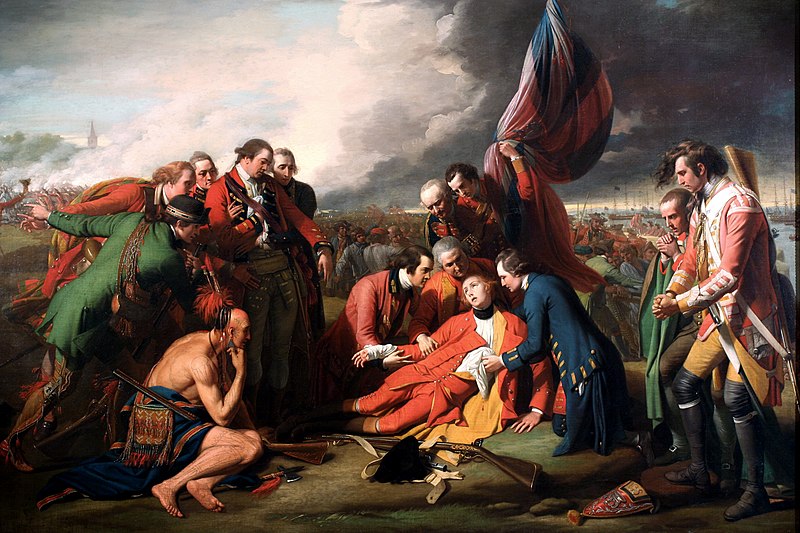 |
| Death of General Wolfe, Benjamin West, 1770 |
 |
| Lady Elizabeth Delmé and her Children, Joshua Reynolds, 1779 |
Peacock has adopted the same hierarchical system, and found Romantic
poetry to wallow at its nadir. On
the other hand, Shelley opined in A
Defense of Poetry that, as the
windhover[iv]
iterated, “reason and imagination are two complimentary entities that all men
should possess … [Romantic] poetry is the vehicle for expressing the
imagination,” central to and inextricable from human nature. For Shelley, poetry
was an eternal entity, the instrument of mystic inspiration that “redeems from
decay the visitations of the divinity in man."[v]
Any “correctness” of either of these contradictory theories (Peacock’s or
Shelley’s) is both arbitrary and impossible to assign. H.F.B. Brett-Smith
affirms the “logical plausibility of Peacock’s argument,” and compares Shelley’s
“anxious poet” to Peacock’s “wicked logician,” but admits that it is ultimately
a moot, subjective argument.
The second facet of Peacock’s thesis is not; he also argues
that, as societies progress towards more rational thought, the value of poetry
in shaping man’s intellect diminishes into eventual irrelevance. Clearly, the 18th Century Enlightenment
–the Age of Reason– would seem an irrevocable blow to this value. Ivy[vi]
aptly recalls, “Peacock says that poetry can never make ‘a useful or rational
man.’ ” It was his view that “in whatever degree poetry is cultivated, it
must necessarily be to the neglect of some branch of useful study: and it is a
lamentable spectacle to see minds, capable of better things, running to seed in
the specious indolence of these empty aimless mockeries of intellectual exertion.” Poetry has reached its saturation
point, and is no longer useful. The
Iron Age has been totally inverted; poetry is no longer the sole intellectual
pursuit, science is. The passive
retreat of the Romantic poet –“who buries himself like a mole”– becomes the
implied reaction to his imminent demise:
Mr. Scott digs up the poachers and
cattle-stealers of the ancient border. Lord Byron cruizes for thieves and
pirates on the shores of the Morea and among the Greek Islands. Mr. Southey
wades through ponderous volumes of travels and old chronicles, from which he
carefully selects all that is false, useless, and absurd, as being essentially
poetical; and when he has a commonplace book full of monstrosities, strings
them into an epic. Mr. Wordsworth picks up village legends from old women and
sextons; and Mr. Coleridge, to the valuable information acquired from similar
sources, superadds the dreams of crazy theologians and the mysticisms of German
metaphysics…
However, the Romantic authors are a good deal more
aggressive than Peacock is willing to give them credit for. Barring the explicit belligerence of
such essays as Wollstonecraft’s A
Vindication of the Rights of Women (also excluded because it is not a work
of poetry), there is a subtle, commendable antagonism within much of the
Romantic Movement that directly attacks the caustic rationality and damaging
industrialism of 19th Century Europe.
Brass Age Romanticism, while certainly a return to traditional forms (indefinable
quality notwithstanding), is not the “innocent and amiable occupation of going
up and down hill, receiving poetical impressions, and communicating them” that
Peacock recognizes. The Romantic poetic
movement had more social and political relevance than ever; through poetry,
thinkers confronted the very issues of Enlightenment and post-Enlightenment
thought that Peacock concluded they were running from.
The first direct challenge to political thought manifests in
the form of several poetic elegies to Napoleon Bonaparte. These poems certainly conform to the artistic
definition of the Brass Age, “rejecting the polish and the learning of the age
of silver, and taking a retrograde stride to the barbarisms and erude
traditions of the age of iron,” and, as Theresa Kelley says, “invok[ing] a
string of precursors”. However,
this is not the haphazard emulation of Golden Age poetic tradition that Peacock
would suggest; it is a good deal more complex. , Andrey[vii]
indicates that Wordsworth misspells Bonaparte as Buonoparte (Italian for good),
but the poem also iterates a disappointment at Napoleon’s failure. Byron’s Ode to Napoleon is unwilling to commit to a full glorification of
Napoleon as well[viii]. He compares Napoleon to Prometheus, the
bringer of fire and enlightenment, and Lucifer, a positive symbol of rebellion
in some post-Miltonic literary circles.
However, Napoleon is also “a nameless thing: / So abject---yet alive!”
(Lines 3,4). There is an imbedded
paradox that is certainly more complex than the primitive glorification of
heroes that Peacock identifies in Brass Age Romanticism. A more fitting work to evidence Peacock’s (and, by
extension, Reynolds’) theory might be Romantic painter Jacques-Louis David’s depiction of Bonaparte crossing the St. Bernard Pass:

It is an effective, dynamic glorification of a war leader,
but nonetheless a portrait, and as such belongs at the bottom of the artistic
hierarchy.
Likewise, Robert Bruce’s Robert
Bruce’s Bannockburn fails as a Brass Age poem because it directly confronts
the issue of Scottish nationalism.
Whereas the varied Odes to Napoleon reinvigorated to a classical,
deceased (well in this case, no longer relevant) historical figure, Bannockburn deals with a deceased
historical figure that is also a
national hero. Katie’s[ix]
comments regarding the depiction of the English as “traitor-knaves” and the “clear
passion and love for the mother-country” makes the work quite politically charged. Ultimately, the [complicated[x]]
call to freedom, “let us DO –OR DIE!” is directed at the people of Scotland,
transcending the historical period of the song. In fact, this was such a powerful piece of national
sentiment that it became the anthem of Scotland. Clearly, Burns’ firsthand influence on the Scottish people
is not an “empty aimless mockery.”
Alex[xi]
previously drew a connection between gender and racial politics; this serves as
the most explicit Romantic challenge to the attacks of Peacock. The
Little Black Boy, available at The William Blake Page[xii],
is a straightforward critique of institutional slavery. The black child “bereav’d of light”
must suffer the injustice of both divinity and white oppression. Katie[xiii]
rightly notices that this is “less subtle” than Blake’s other poems; it is a
direct attack on racism and slavery, and preaches a spiritual transcendence of
race: “I am black, but O! my soul is white” (Line 2). Likewise, Hemans’ Wife of Asdrubal defends rights of women. The Windhover[xiv] suggests that “Hemans glorifies the wife as a heroine figure” and “defends
the wife's efforts to put the ‘woes and passions’ of her children to rest.” By creating an admirable, active female
figure, who retains that admirableness even post-filicide, Hemans is challenging
firm gender stereotypes of the period in a forceful campaign for women’s rights. Blake and Hemans’ socio-political
agendas are hardly “aimless”.
Ultimately, the Romantic Period is not an Age of Brass, but
an Age of Bronze, alike in its aesthetic features, but robust and effective as
a weapon. Romantic poets like
Hemans, Byron and Burns all sought to challenge the supposed rationality and
rampant industrialism of Enlightenment Europe, rather than resign themselves to
insular, background musing surrendered to a rational victory. Theirs is not a “little ambition” or a
“circumscribed perception,” and neither are “ drivellers and mountebanks.” Through their direct challenge of
Enlightenment/post-Enlightenment rationality and politics, the Romantic poets
have forced their way onto equal status with Peacock’s “mathematicians,
astronomers, chemists, moralists, metaphysicians, historians, politicians, and
political economists.”
Works Cited
Brett-Smith, H. F. B. Introduction. The Percy Reprints, No. 3. By Thomas Love Peacock,
Percy Shelley, and Robert Browning. Ed. H. F. B. Brett-Smith. 1820, 1840, 1852. Oxford :
Basil Blackwell,
1921. vii - xxv. Print. The Percy Reprints.
Kelley, Theresa M. "The Case for William
Wordsworth." Rhetorical Traditions and
British
Romantic Literature. Ed. Don H. Bialostosky and Lawrence D.
Needham. Bloomington
and Indianapolis: Indiana UP, 1995. 122-138. Google
Books. Web. 27 Apr. 2012.
<http://books.google.com/books?id=pXOTeiSFEV0C&pg=PR3&dq=napoleon+romantic+literature&source=gbs_selected_pages&cad=3#v=onepage&q=napoleon%20romantic%20literature&f=false>.

No comments:
Post a Comment