Kelsey Walters
Romanticism 254b
Professor Porter
26 April 2012
Negotiating Romantic Relationships
Romantic literature paints a complex
portrayal of the power dynamic between man and woman in society, with marriage as
the ultimate embodiment of social constructs of gender roles and relations. Concern
over gender inequalities—and an attempt to negotiate a solution to these
inequalities through romantic relationships—pervades the literature we have
surveyed this semester. Social, cultural, and political influences spanning the
late 18th to mid 19th centuries crafted careful gender
schemas that defined masculine and feminine identities A comparison of
selections from Reeve, Godwin, Austen, and Hemans allows for an examination of
the nature of gender stereotypes and their influence on sexual-marital
relationships, where the struggles the individual faces in negotiating
opposite-sex relationships reflect an embodiment of the difficulty of escaping
contemporary gender ideals
While
facing a changing economic and political climate in the wake of the British
Industrial Revolution and the French Revolution of 1789, Romantic-era British
society was still heavily entrenched in a “convoluted patriachalism” that
shaped its “social, economic, and interpersonal relationships” (Watkins 1998),
including gender relations and the institution of marriage. Though legislation
such as the Reform Bills passed by Parliament in 1832 would help further the
rights of the working-class man (Mellor and Matlak 9), little changed for the
rights of women and many still found themselves living a life of mistreatment,
subordination, and inferiority at the hands of their male counterparts. Female
Romantic writers such as Felicia Hemans lamented the state of inequalities in
gender relations through their literary works and political views, censuring
the imbalance in gender relations, especially in the confinement of women to
the domestic sphere after entering into the union of marriage, when “that
sphere failed to support the women and children it supposedly protected”
(1180).
In
his lamentations on marriage and cohabitation in “Enquiry Concerning Political
Justice and Its Influence on Morals and Happiness,” William Godwin provides a
unique portrayal of gender relations that, as noted by The Windhover in his post
about Godwin, tends towards a feminist point of view. Godwin cites the fallacy
of the marital union as if both parties have an equal share of unhappiness, yet
notes that as long as “I seek by despotic and artificial means, to maintain my
possession of a woman, I am guilty of the most odious selfishness” (Godwin 94).
This implies a role self-fulfillment (albeit burdened by guilt) for the man in
the relationship, at the price of subjecting the woman to a position of
inferiority, and undoubtedly excessive discontentment. Marriage exists as an
inherently problematic relationship due to its restriction of the individual
liberties and inclinations of man and wife, and “so long as two human beings
are forbidden, by positive institution, to follow the dictates of their own
mind, prejudice will be alive and vigorous” (94). The burden of this type of
union, enforced by social standards, imposes on the liberties of both men and
women. Godwin further characterizes marriage as less of a romantic relationship
and more of a social contract (94), unhappily entered into as a result of
misled philosophies on the nature of domestic felicity. He especially puts
forth a critical view of Romantic society for the way in which marriages are
arranged when he notes that, “The method is for a thoughtless and romantic youth
of each sex to come together, to see each other, for a few times and under
circumstances full of delusion, and then to vow eternal attachment” (94).
Godwin proposes an elimination of this socially-constructed ideal of relations
between men and women. The pursuit of individual happiness, for both of the
sexes, may only be achieved when each individual has the freedom and agency to
choose his own partner and to suit his own desires, whether they be
romantically, socially, or economically motivated. Gratification, happiness,
and fulfillment in the relations between the sexes cannot occur when such
relations are socially imposed, especially when such imposition occurs in the
vein of institutionalized patriarchal social values, and is thereby biased
against the happiness of women.
Unlike
Godwin, Clara Reeve saw the problem of the relations between the sexes not as
stemming from a loss of individual independence upon entering into the marital
union, but as a lack of equality in the relationship (Mellor and Matlak 152). The
solution of an egalitarian marriage, with equal rights, responsibilities, and
opportunities for husband and wife (152), would promote domestic and social
felicity. Egalitarian marriages would also change the societal gender
standards, affording women equal rights and recognition. In excerpts from
“Evening V” and “Evening XII” of The
Progress of Romance, Reeve uses the form of a didactic conversational
dialogue between one male and two female speakers to comment on the
transformation of literature from the Romance to the Novel, and influence of
literature on contemporary young men and women. Like Godwin’s unconscious
advocacy of gender equality through derision of the limiting nature of marriage
on both sexes, Reeve argues for the existence of a female intellectual
fortitude and rationality comparable to, if not greater, than, that of the
male. She demonstrates female equality through Euphrasia’s argumentative
triumph over Hortensius. After much banter, Hortensius admits that, “I am
astonished—admonished—and convinced! I cannot deny the truth of what you have
advanced…” (Reeve 156).
Despite
the symbolic feminism conveyed by this intellectual victory, the strongly
patriarchal values instilled in Euphrasia cast a blemish over this would-be
female triumph over typically dominant masculinity: though providing a solid,
winning argument founded in logic, in concluding, Euphrasia laments that “As a
woman I cannot give this argument its full weight” (156). This undercuts the
strength of the blow that defeated her male intellectual competitor and
provides Reeve with an opportunity for social critique. Though the woman wins
the argument, she ultimately recalls the patriarchal values ingrained in her
psyche and belittles her own ability, and thereby her value, as a woman.
As
Andrey relates in his post “Euphrasia’s Incomplete Argument,” and Alex counters
in a subsequent comment, Euphrasia’s lessening of the magnitude of her cerebral
victory reflects masculine fear of the shifting culture, the desire to hold on
to traditional gender roles, and the difficulty women faced in changing these
solidly entrenched norms. Alex further argues that, “perhaps Reeve is trying to
make a statement about the underlying contempt…that men, in general, felt as
women gained more rights to education and literacy at the time.” Mary
Wollstonecraft cites in her “Vindication of the Rights of Women” one of the
major problems in negotiating gender relations as gender inequality due to a
lack of education and rationality on the part of the female sex (381); with the
creation of the British Circulating Libraries (Mellor and Matlak 155) in the
1780s such that the number of educated, literate women increased, the
possibility of gender equality increased. Lending libraries, such as Chetham’s
Library pictured below, gave public access to literature on subjects such as
history, biology, philosophy, and theology (Melton 108), granting free exposure
to important topics to a broader literary audience.

Changing Romantic
social institutions presented the possibility of progress, from the conception
of the only possible relationship between the sexes as having “the young men to
look upon themselves as the champions and protectors of the weaker sex” and the
“young women to deport themselves too much like Queens and Princesses” (Reeve
154), to a coexistence between men and women as equals. The genders could
mutually benefit from, and find happiness and love in, a permanent romantic
relationship.
Jane
Austen presents another perception of the complexities of negotiating the
romantic relationship in her novel Persuasion.
Through the contrasting relationships of the idyllic, egalitarian union between
Admiral and Mrs. Croft, and the miserable relationship between Mary and Charles
Musgrove—characters marrying more for social graces, obligations, and money,
than love or consideration for one another (Austen 48) —Austen evinces the
possibility of a new kind of sexual relationship, one where man and woman marry
for love and companionship, instead of social or familial necessity. Carly K explores
this idea of Austen’s in her post “Admiral and Mrs. Croft in Persuasion,”
remarking on the shift from traditional to more modern gender portrayals
throughout the novel, and throughout Romantic literature as a genre (Mellor and
Matlak 366). As a couple that could have “no two hearts so open, no tastes so
similar, no feelings so in unison” (Austen 59), the Crofts exemplify a union of
gender harmony that fails to succumb to the archaic and masculine-centered
concerns about social status, financial security, public male dominance, and
domestic female submission. Knw similarly explores this diversion from typical
gender roles and relationships in Persuasion
in the role of agency and female power in her post “Independence in Persuasion.”
She traces the development of Anne Elliot, from a girl embodying typical
Romantic conceptions of the subordinate female, susceptible to the persuasive
influences of the opinions of her social network and a sense of familial duty
(Austen 66), to an independent woman marrying Captain Wentworth for love and an
exertion of her own right to happiness.
While
Godwin rejects the idea of any possibility of happy equality in an institution
so restrictive of individual liberties as marriage, and Reeve presents the
fallacy of challenging gender stereotypes and relationships because of
entrenched social values, Austen offers a solution to the difficulty of
negotiating the male-female relationship: through a union of equals forged for
the purpose of mutual love, affection, and respect, a man and woman may retain
their individual identities, preserve social cohesion, and ensure domestic
felicity. Only when underlying inequalities in social constructions of gender
roles and stereotypes have been remedied will male-female relationships
prosper.
A
third alternative solution to the problem of gender inequality and
relationships emerges in Felicia Hemans’ poem “The Wife of Asdrubal.” Published
only two years after Austen’s Persuasion,
“The Wife of Asdrubal” reflects the impossibility of a shift away from
traditional gender relations. In Aly’s post about the poem, she delineates the
reversal of gender roles such that Asdrubal stands “Ignobly safe amidst conquering
bands,” (Hemans 40) having cowardly abandoned his country and family, while his
wife perseveres as an “avenging goddess” (32), and suggests that an adoption of
this persona of powerful avenger may be necessary to change contemporary gender
roles.
However,
this physical gender role reversal becomes shockingly complicated when the wife
of Asdrubal brutally murders her own children, to punish her husband for his
abandonment (45-56), and also to spare her children from the shame of their
father’s cowardice, help them escape the inevitably more painful death of
burning alive, and in so doing reveal a strangely irrefutable sense of
maternity (Aly 4/16/2012). Like Reeve’s belief in the impossibility of usurping
ingrained social standards of gender, Hemans’ depiction of the brave but still
instinctively maternal wife shows that even in circumstances of extremity,
inherent inequality in gender relations will force adherence to prescribed
behaviors; furthermore, this unequal nature in gender dynamics causes the
eternal, universal suffering of the “weaker” sex. Hemans’ personal belief in
“all the ways in which the values of hearth and home are betrayed: by men who
prefer fame and fortune to love, by men who…follow a chivalric code of honor
that willingly sacrifices the good of the family to the needs of the state” (Mellor
and Matlak 1180) mirrors themes of female suffering illustrated in visual art
of the Romantic era. In particular, the depiction of women as hopeless victims
of masculine rejection and false ideals is reflective of Hemans’ philosophies (Kim),
as can be seen in John Everett Millais’ painting Mariana below.
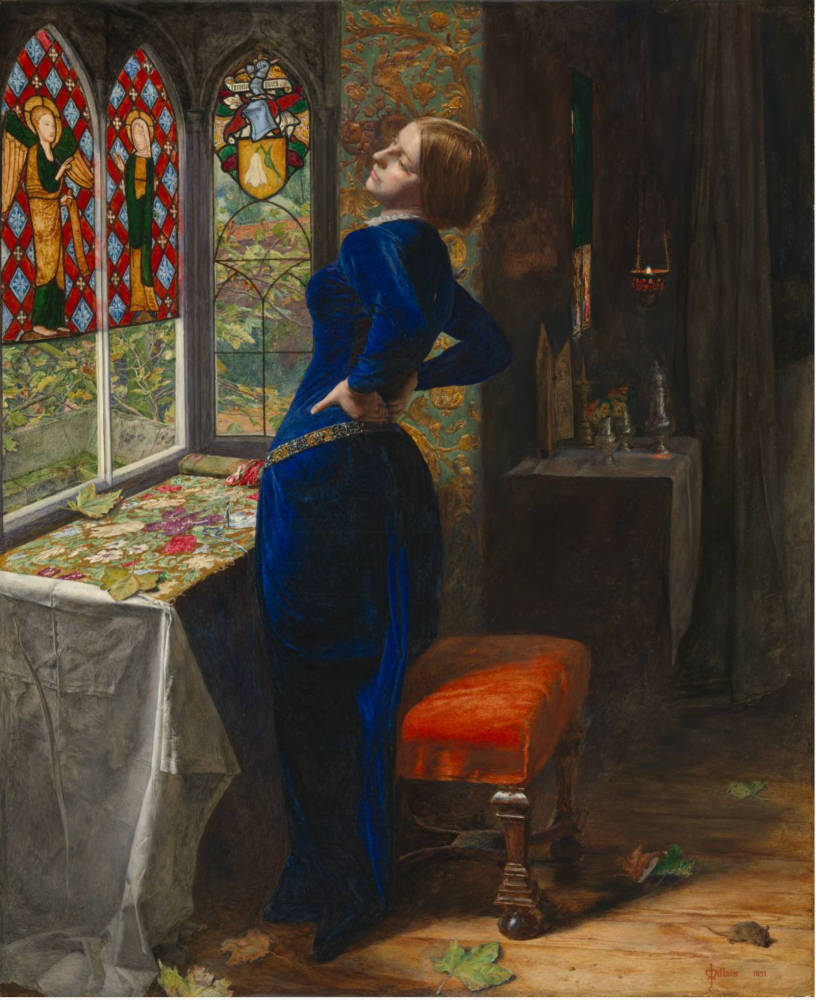
Millais
relates this theme of feminine grief due to victimization by masculine cruelty
and rejection in his painted rendition of Tennyson’s lyrical poem “Mariana,”
depicting the tragic figure of the woman suffering from unrequited love in an
atypical “sensuous stretching pose” (Kim). Like the wife of Asdrubal, Millais’
Mariana expresses her grief in a way that defines constriction of the social
conventions of her time.
A
painful realization manifests when considering the relationship between the
sexes through a comparison of the fates of the subjects in the works of Reeve,
Hemans, Godwin, and Millais: despite changes in social, political, and economic
institutions of Romantic Britain, the failure of the female characters to
achieve ideal outcomes reveals the lack of progress in equalizing the genders.
Unequal individual standing translates to the impossibility of negotiating a
relationship between man and woman that results in a happy union of equality,
romance, and companionship.
Works Cited
Austen,
Jane. Persuasion. Ed. Linda Bree.
Toronto: Broadview Publishing 1998. Print.
Gladden,
Samuel. Rev. of Sexual Power in British
Romantic Poetry, by Daniel P.
Watkins. Romantic Circles Reviews. 10 Mar. 1998: 2(1). Web.
Godwin,
William. “Enquiry Concerning Political Justice and Its Influence on Morals and
Happiness.” 90-95.
Hemans,
Felicia. “The Wife of Asdrubal.” 1179-1247.
Kim, Hae-In. “The Pre-Raphaelite Women Destroyed by
Love in All Its Forms and
Fates.” Victorian Web. Web. 23 Mar. 2012.
Mellor,
Anne and Matlak, Richard, eds. British
Literature 1780-1830. Wadsworth:
Cengage Learning, 1996. Print.
Melton,
James. The Rise of the Public in
Enlightenment Europe. New York: Cambridge
University Press, 2001. Print.
Millais,
John Everett. Mariana. 1850. Oil on
canvas. The Matkins Collection, Tate
Gallery, London.
Reeve,
Clara. “The Progress of Romance.” Mellor and Matlak. 152-156.
Wollstonecraft,
Mary. “Vindication of the Rights of Woman.” 373-405.

No comments:
Post a Comment